M
06
Policy & Campaign

Taking it outside the store.

Four days of missions produced more than survey data. We wrote to convenience store chains with a concrete accessibility proposal, and opened a public photo campaign so anyone can help make the problem visible.

정책 제안 · Policy proposal

An accessibility proposal, sent to the chains.

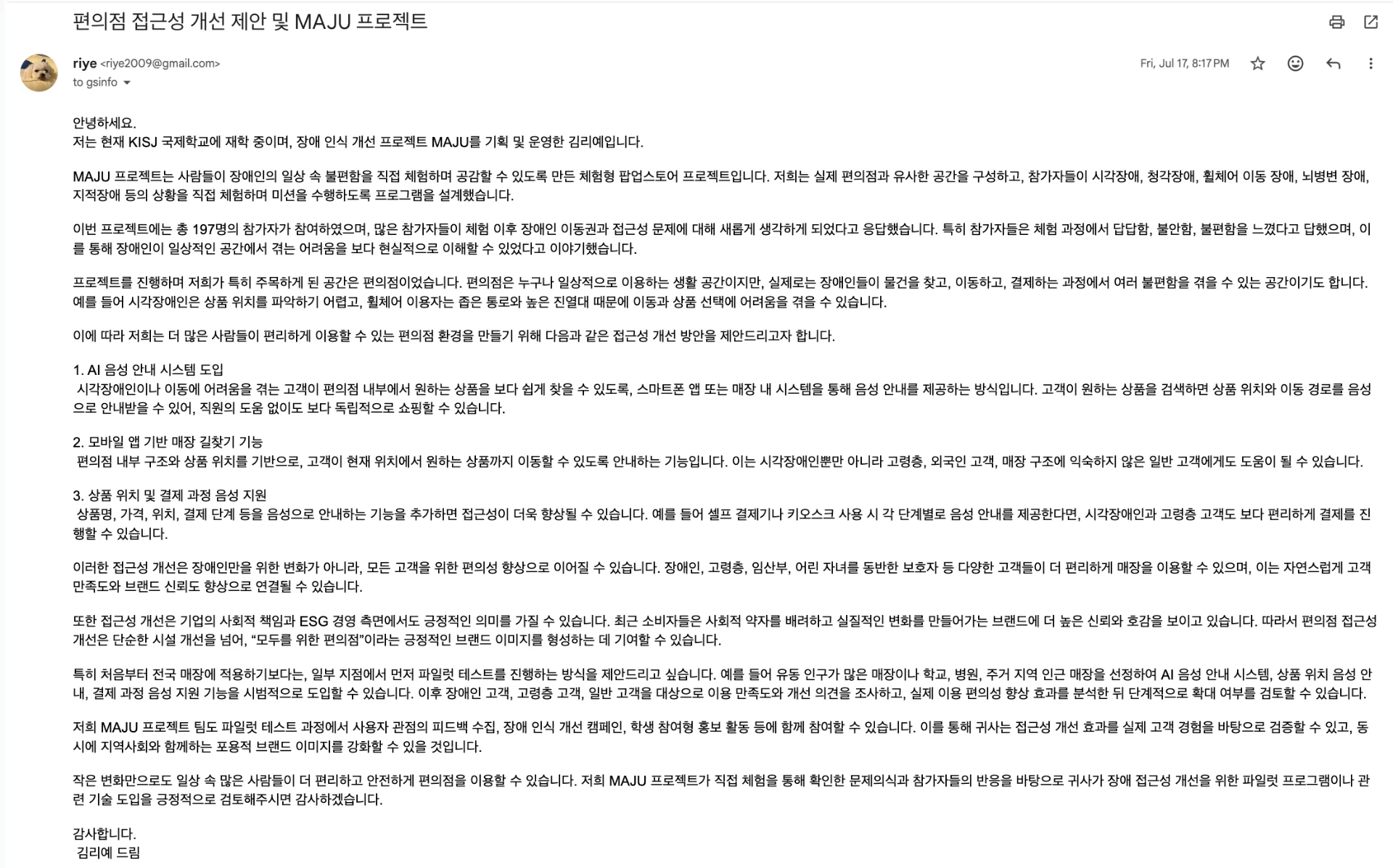
The convenience store is a space everyone uses daily — and one where disabled customers repeatedly run into trouble finding products, moving through aisles, and paying. Visually impaired customers can't tell where an item sits; wheelchair users are blocked by narrow aisles and high shelving. We sent the following three proposals to store operators, together with what our 197 participants reported.

P.01Proposal

AI voice guidance in-store

AI 음성 안내 시스템 도입

Visually impaired customers, or anyone who struggles to move through a store, search for a product on a phone app or in-store system and hear where it is and how to get there — shopping independently, without needing staff help.

P.02Proposal

App-based store wayfinding

모바일 앱 기반 매장 길찾기

Turn-by-turn guidance from where the customer stands to the product they want, built on the store's layout. Useful far beyond disability: older shoppers, foreign visitors, and anyone unfamiliar with the store.

P.03Proposal

Voice support for pricing and checkout

상품 위치 및 결제 과정 음성 지원

Product name, price, location, and each step of payment read aloud. Spoken prompts at self-checkout and kiosks make paying manageable for visually impaired and elderly customers.

The accessibility proposal email sent to convenience store operators, written in Korean
Fig. 06 — The proposal letter, sent 17 July
Sent mail list showing the proposal delivered to three convenience store companies
Fig. 07 — Sent to three operators

The Maju Project team offered to join any pilot directly — collecting user-perspective feedback, running awareness campaigns, and organising student-led promotion alongside the company.

01

Convenience for everyone

Accessibility isn't a change for disabled customers alone. Elderly shoppers, pregnant customers, and parents with small children all move through a store more easily — which raises satisfaction across the board.

02

ESG and brand trust

Consumers increasingly trust brands that make real, visible change for people who are underserved. Accessibility work goes beyond facilities — it builds a “convenience store for everyone” image.

03

Start with a pilot

Rather than a nationwide rollout, begin at a handful of branches — high-footfall stores, or ones near schools, hospitals, and residential areas — then survey disabled, elderly, and general customers before scaling.

캠페인 · Photo campaign

Two photos, two points of view.

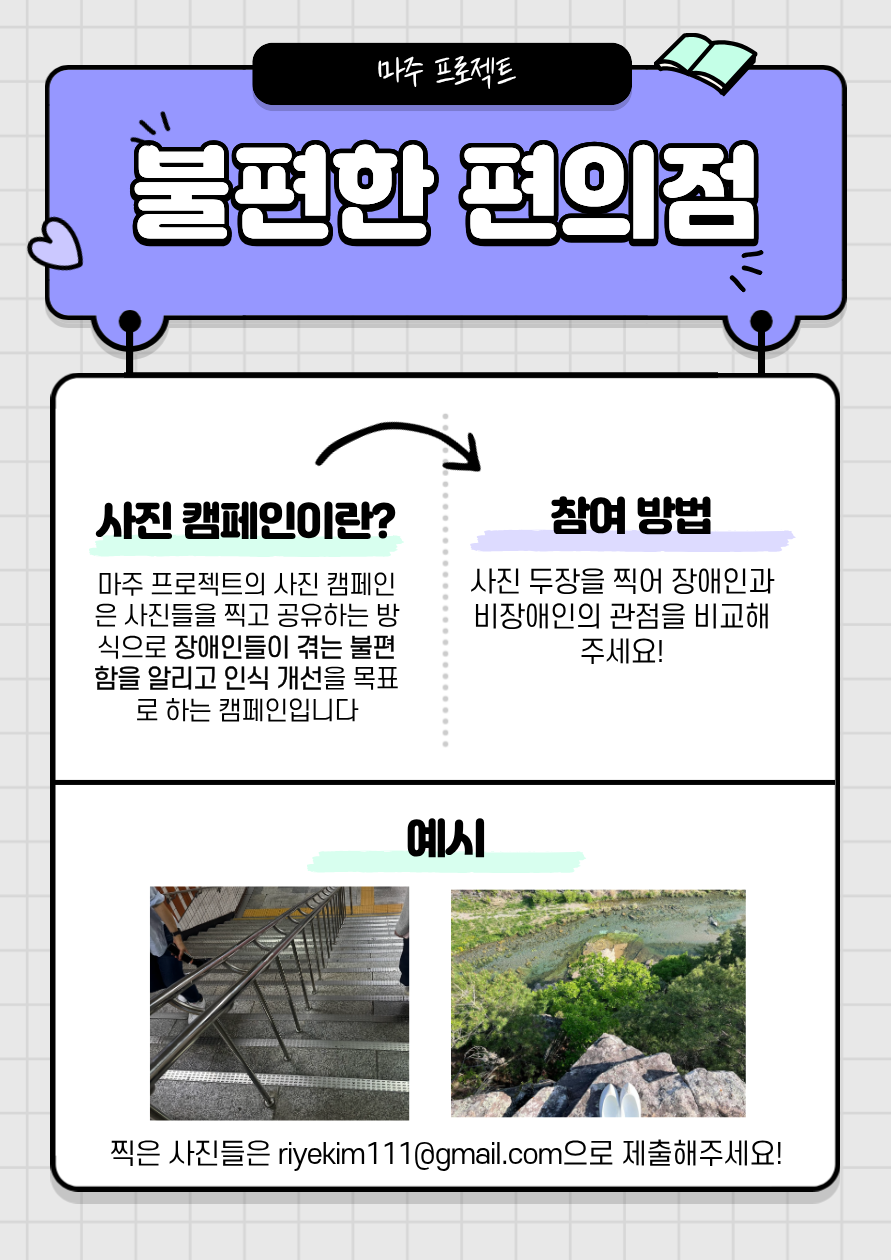
The Maju Project photo campaign asks people to photograph and share the inconveniences disabled people face every day — the stairs with no ramp, the path that ends in a kerb, the entrance that only works one way.

How to take part: shoot two photos of the same place — one from a disabled person's point of view, one from a non-disabled person's — so the difference is impossible to miss.

Send your photos to riyekim111@gmail.com.

2
photos per submission — two perspectives
Open
anyone can join, anywhere
Maju Project photo campaign poster explaining how to submit two photos comparing disabled and non-disabled perspectives
Fig. 08 — Photo campaign poster
"Even a small change lets many more people use an everyday space comfortably and safely."
— from the proposal letter, Kim Riye, The Maju Project